Multi-Pet Household Harmony: Managing Dogs and Cats Together
Welcome to Our Beautifully Chaotic Multi-Pet Family
Want to know what multi-pet household harmony really looks like? It’s Luna perched confidently on London’s shoulder while he games, Penelope claiming her sunny windowsill for afternoon meditation, and Boomer sprawled across the office floor. They coexist in the same space without a hint of tension. But let me tell you, achieving this multi-pet household harmony didn’t happen overnight.
Here’s the truth about multi-pet household harmony: successfully integrating dogs and cats requires understanding each species’ communication styles and creating systems that prevent conflicts while encouraging positive interactions.
Multi-pet household harmony means creating an environment where different species can coexist peacefully without forced friendships or instant love. Instead, focus on respecting individual adaptation rates and designing spaces where every family member feels genuinely secure.
From separate resource areas that prevent competition to gradual integration strategies that build trust over time, every element matters. Each choice becomes an opportunity to create a home where different species can thrive together.
This guide shares the real-world strategies we’ve developed through our journey with Boomer’s gentle personality, Luna’s quick kitten adjustment, and Penelope’s more cautious adult approach.
For species-specific guidance, see our comprehensive guides on dog-friendly home design and cat sanctuaries at home that complement these multi-pet strategies.
What Does Multi-Pet Household Harmony Really Mean?
Multi-pet household harmony is the creation of home environments where dogs and cats coexist peacefully through strategic resource management, respect for individual communication styles, and gradual trust-building. Unlike forcing inter-species friendships, true harmony focuses on preventing conflicts while allowing natural positive relationships to develop at each animal’s own pace.
This matters because dogs and cats have fundamentally different social structures and communication methods. When we honor these differences through thoughtful space design and routine management, we create households where every animal feels secure and valued.
Understanding Cross-Species Communication in Multi-Pet Household Harmony
Successfully managing dogs and cats together starts with recognizing that these species literally speak different languages. Dogs are naturally social pack animals who communicate through body language, vocalizations, and direct interaction. Meanwhile, cats are more territorial and subtle in their communications. They prefer indirect approaches and maintain personal space boundaries.
Research from the American Veterinary Society of Animal Behavior shows that most multi-pet conflicts arise from inadequate resource separation and misunderstood communication signals. True aggression is actually rare. This understanding forms the foundation for successful multi-pet household harmony.
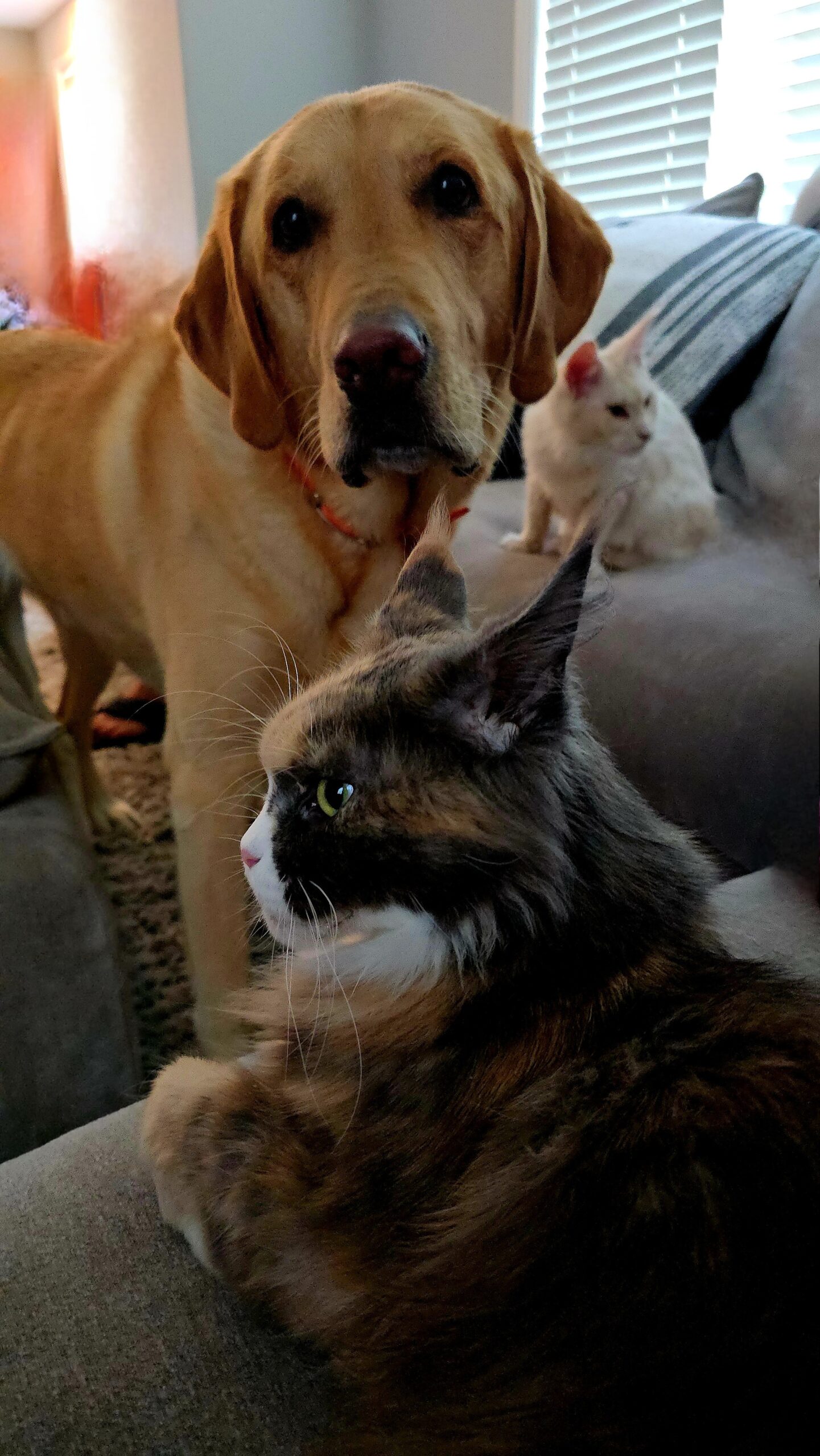
Our multi-pet household harmony largely stems from Boomer’s naturally gentle temperament. His patient observation of feline behavior without reactive chasing helps anxious cats feel secure. Respectful boundary recognition and calm energy also contribute to shared space comfort.
Boomer’s success with cats stems partly from being raised with our previous cat Marley. Meanwhile, Penelope and Luna’s adaptation required more patience. They’d never lived with dogs before joining our family.
The key to multi-pet household harmony lies in learning to read and respect these different communication styles. When Boomer shows his relaxed “play bow” posture around the cats, we quietly reward him with treats. When Penelope offers slow blinks from her elevated perch, we acknowledge her trust without forcing interaction. Small moments of recognition like these build lasting household peace.
Managing Different Adaptation Rates for Multi-Pet Household Harmony Success
Perhaps the most crucial aspect of multi-pet household harmony involves respecting that every animal adapts to change at their own pace. Luna’s quick kitten adjustment contrasted dramatically with Penelope’s cautious adult approach. This experience taught me valuable lessons about patience and individualized integration strategies.
Luna’s Fearless Kitten Adventure
Luna’s rapid adjustment to multi-pet household life demonstrates how younger animals often integrate more easily into established family structures. Her natural kitten curiosity and adaptability meant she approached Boomer with interest rather than fear. Within days, she was confidently walking beneath his gentle gaze. She even attempted to play with his slowly wagging tail.
The secret to Luna’s success lay in providing her with secure base camps where she could retreat when overwhelmed. We also allowed natural investigation to unfold at her own pace.
We started with visual contact through a portable play pen, progressed to supervised meetings, and eventually allowed free access. This progression happened once we saw calm, positive body language from both species.
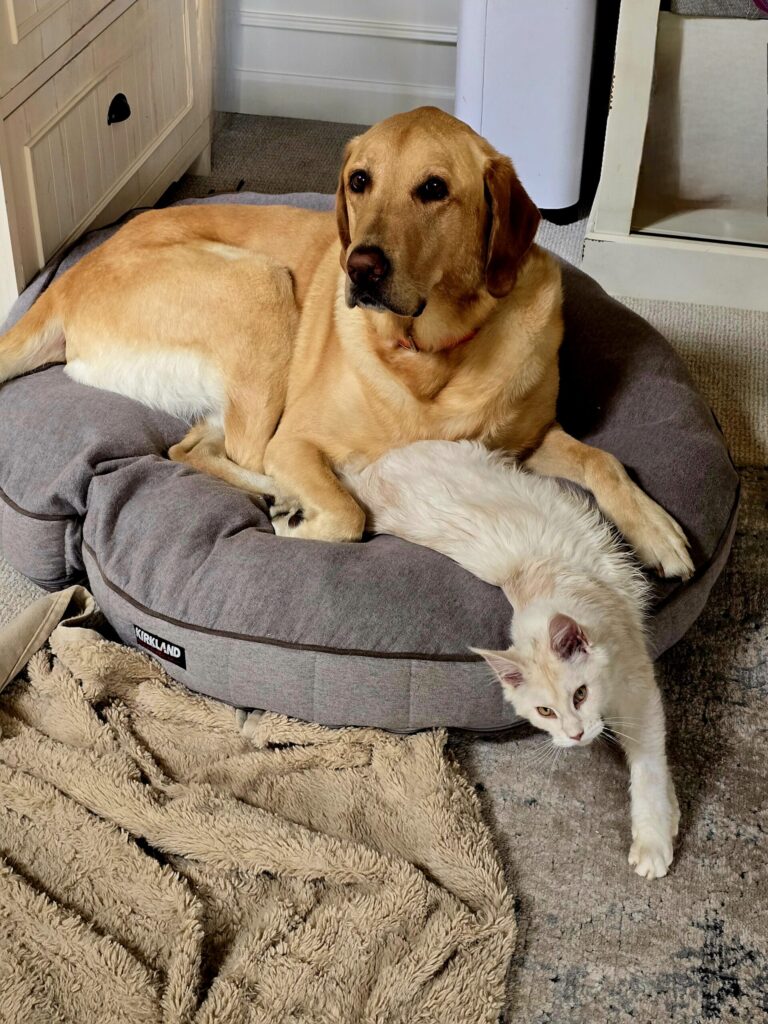
Luna’s college preparation also played into her integration success. For complete guidance on preparing cats for major transitions, see our comprehensive guide on bringing your cat to college as an emotional support animal. Creating confidence through secure environments helps young animals develop the resilience needed for complex social situations.
Penelope’s Dignified Assessment Process
Penelope’s more cautious integration reflects the reality that adult cats need time and space to assess major life changes. Her approach reminded us that slower adaptation doesn’t indicate failure – it demonstrates wisdom and self-preservation instincts that deserve respect.
Adult cats like Penelope arrive with established territorial preferences, daily routines, and sometimes past experiences that influence their comfort levels. Her dental recovery added another layer of complexity. Cats healing from medical procedures often feel more vulnerable during transition periods. For detailed information about supporting cats through dental challenges, read our guide on what adopting Penelope taught me about cat dental health.
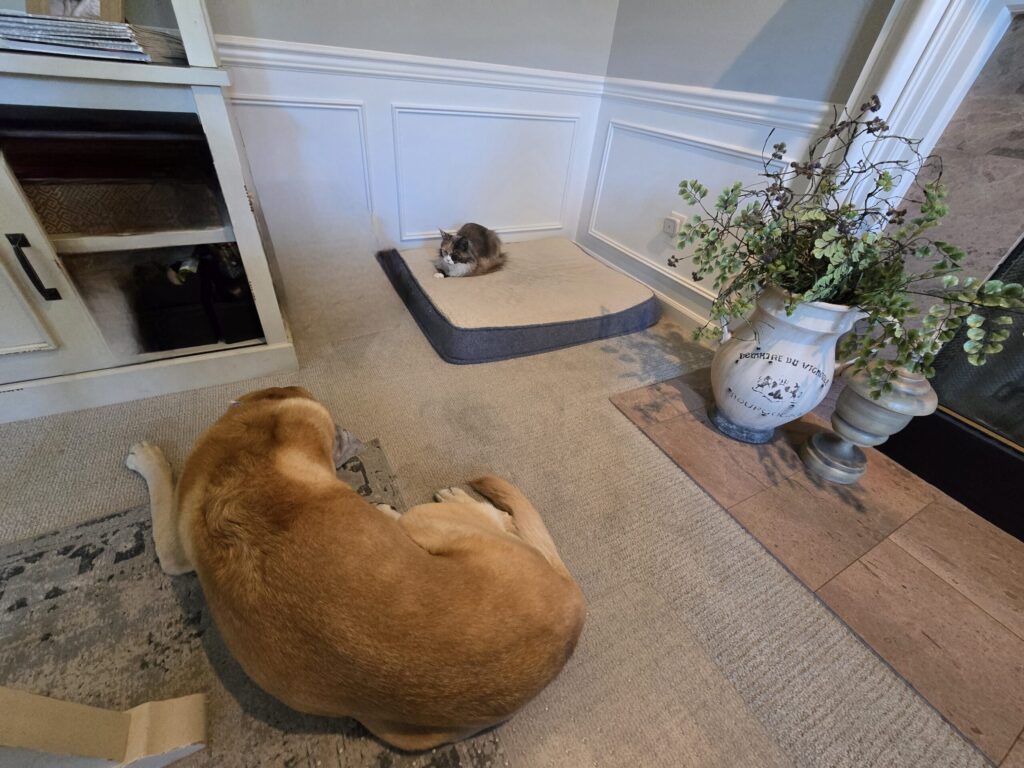
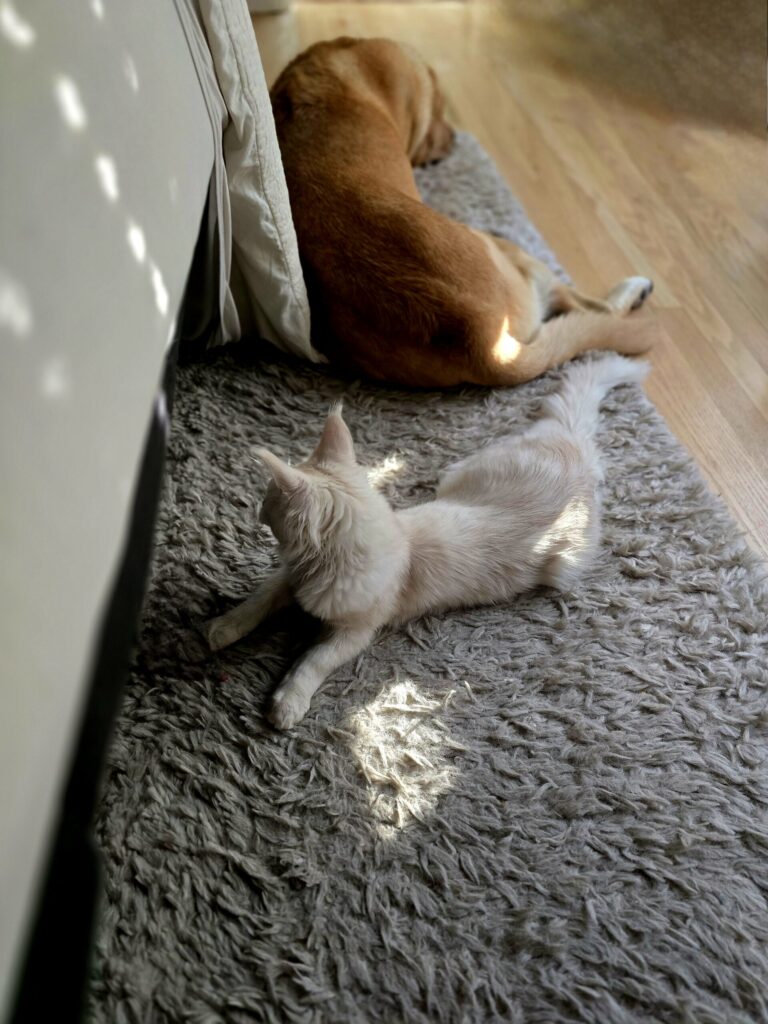
Her breakthrough moment came about six weeks into her stay. I found her and Boomer peacefully sharing the sunny morning kitchen space – not interacting directly, but comfortable in each other’s presence. This parallel coexistence became the foundation of their relationship, proving that multi-pet household harmony doesn’t require friendship, just mutual respect and security.
Essential Strategies for Multi-Pet Household Harmony
Creating sustainable multi-pet household harmony requires specific strategies. These address the practical challenges of managing different species with different needs, schedules, and preferences.
Separate Resource Areas: The Foundation of Peace
The cornerstone of successful multi-pet households lies in providing separate resource areas for feeding, drinking, and elimination. Competition over essential resources creates stress and conflict, while separated areas allow each animal to meet their needs without anxiety.
Feeding stations
Boomer’s ground-level feeding area in the kitchen works perfectly for his routine, while elevated cat feeding stations keep Luna and Penelope’s meals accessible to them but completely dog-proof. I learned this lesson the hard way when Boomer’s enthusiasm for cat food created tension during early mealtimes. It was also adding unwanted calories to his diet – something we were actively trying to avoid. Now, the cats dine peacefully three feet above his reach, feeling secure while eating without rushing or guarding behaviors.
water sources
Water sources throughout our home ensure adequate hydration for all pets while preventing competition. Multiple locations also accommodate different preferences – Luna loves drinking from her fountain in London’s room, while Penelope prefers still water in quiet locations away from household activity. Boomer, predictably, will drink from anywhere and everywhere.
litter box placement
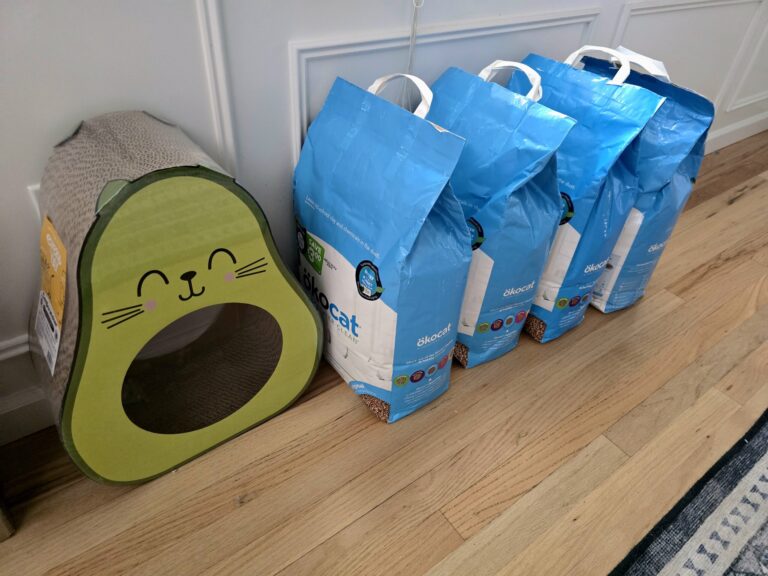
Litter box placement requires special consideration in multi-pet households. The Cornell Feline Health Center recommends one box per cat plus one extra, positioned in different areas away from dog traffic. This prevents territorial conflicts between cats while ensuring they always have private, secure elimination options.
Individual Attention: Preventing Competition and Jealousy
Each pet in our multi-pet household needs focused human interaction without competition from other animals. This individual attention prevents jealousy and reinforces positive behaviors. It maintains strong human-animal bonds despite the complexity of multiple relationships.
Boomer’s morning office time provides him with undivided attention and maintains his role as my primary work companion. These quiet moments together, complete with belly rubs and gentle conversation, reassure him that adding cats to our family doesn’t diminish his importance.
Luna’s evening gaming sessions with London strengthen their special bond while giving her dedicated play and affection time that honors her kitten energy. Penelope’s quiet afternoon windowsill conversations respect her more reserved personality while ensuring she receives the gentle attention she craves.
The magic happens in these individual moments when each animal receives undivided human attention. Their personalities shine through without competition, and bonds deepen through focused interaction that celebrates their unique traits and preferences.
Creating Escape Routes and Vertical Territory
Multi-pet household harmony depends heavily on providing escape routes. This is especially important for cats who need multiple exit strategies from any shared space. Every room in our home offers clear pathways. These allow cats to retreat quickly if they feel overwhelmed by dog energy or general household activity.
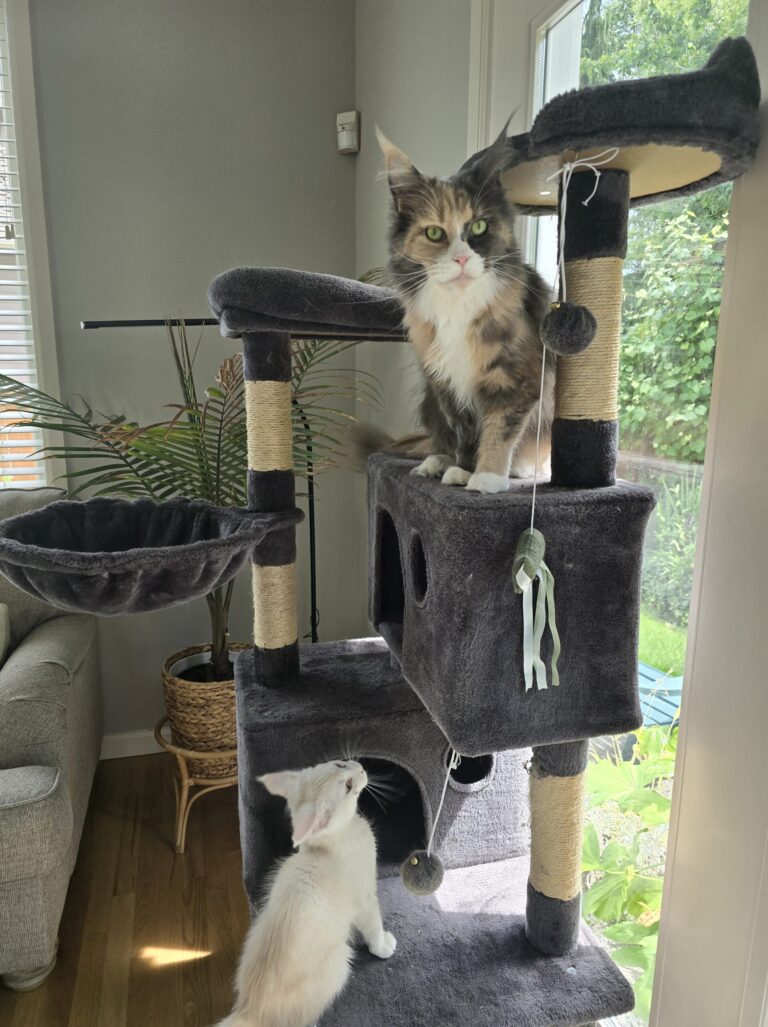
Vertical escape routes have become especially important in our multi-pet home. Cat trees positioned strategically throughout the house, wall shelves that create aerial highways, and elevated hiding spots all provide security. Dogs simply cannot access these vertical zones. These vertical territories serve as stress relief zones where cats can observe household activity while feeling completely safe and in control.
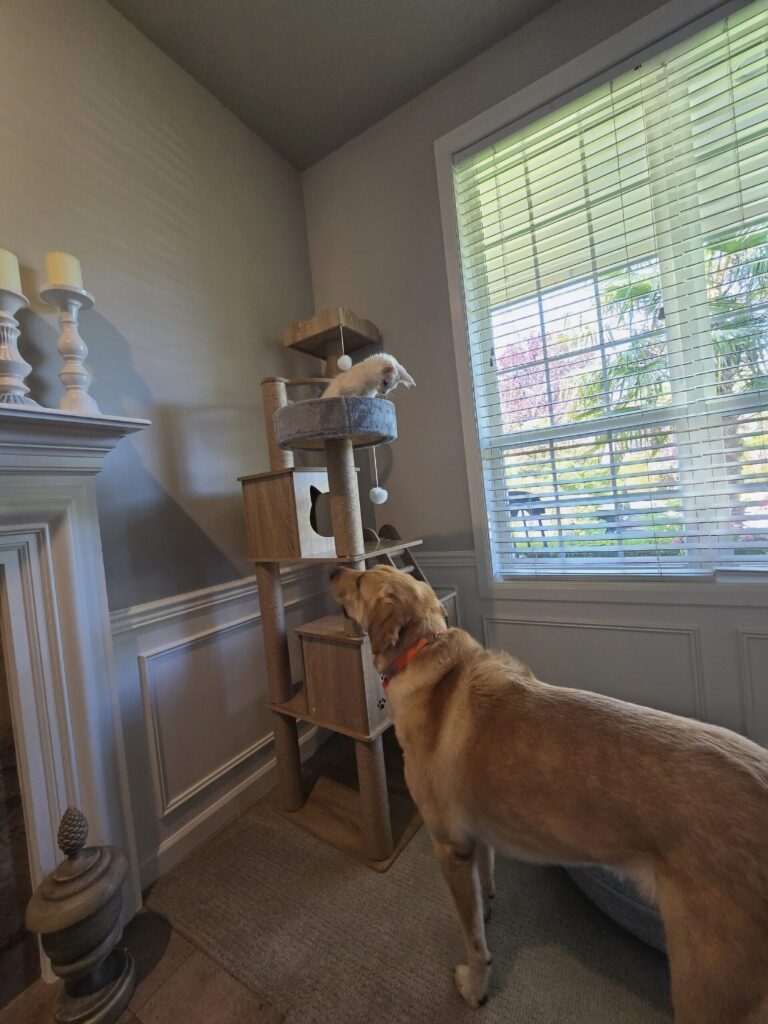
Luna has claimed the top of the entertainment center as her personal observation deck, while Penelope prefers the sunny cat tree near the window. From these elevated positions, they can monitor Boomer’s activities and choose when – or if – they want to engage with ground-level happenings. This choice becomes crucial for maintaining their sense of security and autonomy.
Building Positive Associations in Multi-Pet Household Harmony
Creating positive associations between different species requires patience, consistency, and strategic timing that builds pleasant connections rather than forced interactions. The goal is helping pets associate each other’s presence with good things happening, not manufacturing artificial friendships.
Some of our most successful multi-pet household harmony develops through parallel activities where different species engage in complementary behaviors simultaneously. Morning routines where Boomer accompanies me for coffee while cats claim sunny breakfast spots create peaceful coexistence. There’s no pressure for direct interaction.
I’ve learned to time special treats during naturally calm moments when multiple pets share space peacefully. When Penelope and Boomer happen to rest in the same room quietly, gentle treat distribution reinforces this positive coexistence. We avoid creating expectations for interaction. These moments build trust gradually while creating pleasant memories associated with each other’s presence.
Evening wind-down routines provide another opportunity for positive associations. As daylight fades, each animal naturally settles into their preferred resting spots – Boomer on his bed beside ours, Luna curled up with London, and Penelope claiming her favorite windowsill perch.
This household-wide relaxation creates a peaceful energy that benefits everyone without requiring any forced socialization.
Troubleshooting Common Multi-Pet Household Harmony Challenges
Even the most harmonious multi-pet households encounter occasional challenges that require thoughtful intervention and creative problem-solving. Understanding common issues and having strategies ready helps maintain peace when problems arise.
Resource guarding can develop when animals perceive scarcity or competition over valuable items. I discovered this early when Boomer’s enthusiasm for cat treats created tension during feeding times. The solution involved ensuring abundant resources and completely separate feeding areas. This eliminated any possibility of competition. Now each animal has secure access to their needs without pressure from others.
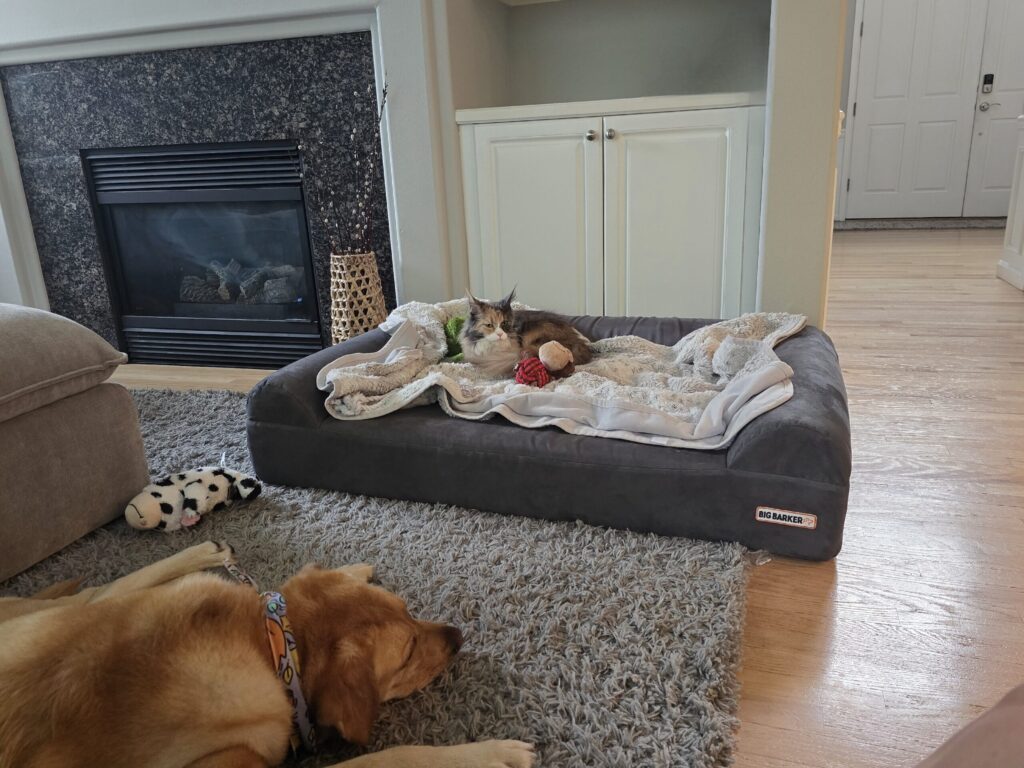
Energy level mismatches often create household tension. High-energy dogs can overwhelm cats who prefer calm environments. Boomer’s natural gentleness helps, but even he can become excited during play times that might stress the cats. We’ve learned to provide adequate exercise and mental stimulation for everyone through species-appropriate activities. We also create designated quiet zones where lower-energy pets can retreat when needed.
Recognizing stress signals allows for early intervention before conflicts escalate into serious problems. Cat stress signals include hiding for extended periods, changes in eating habits, or litter box avoidance. Dog stress signals might include destructive behavior, excessive attention-seeking, or hypervigilance around other pets. The ASPCA provides excellent resources on multi-pet household management for situations requiring additional professional guidance.
Early intervention usually involves temporarily increasing individual attention or reviewing our environmental setup for improvements. Sometimes we provide extra retreat options until stress levels decrease. Most challenges resolve quickly when we address the underlying cause rather than just managing symptoms.
Boomer's Take

"When the tiny white one first arrived, I wasn't sure what to make of her boldness. Then came the fluffy lady who needed her space – I understood that. Now? Luna uses me as her personal jungle gym, and Penelope occasionally steals my bed. But you know what? The house feels fuller somehow. More alive. Just don't tell them I let Luna win when we play chase. A gentleman never tells."
Building Your Multi-Pet Household Harmony Success Story
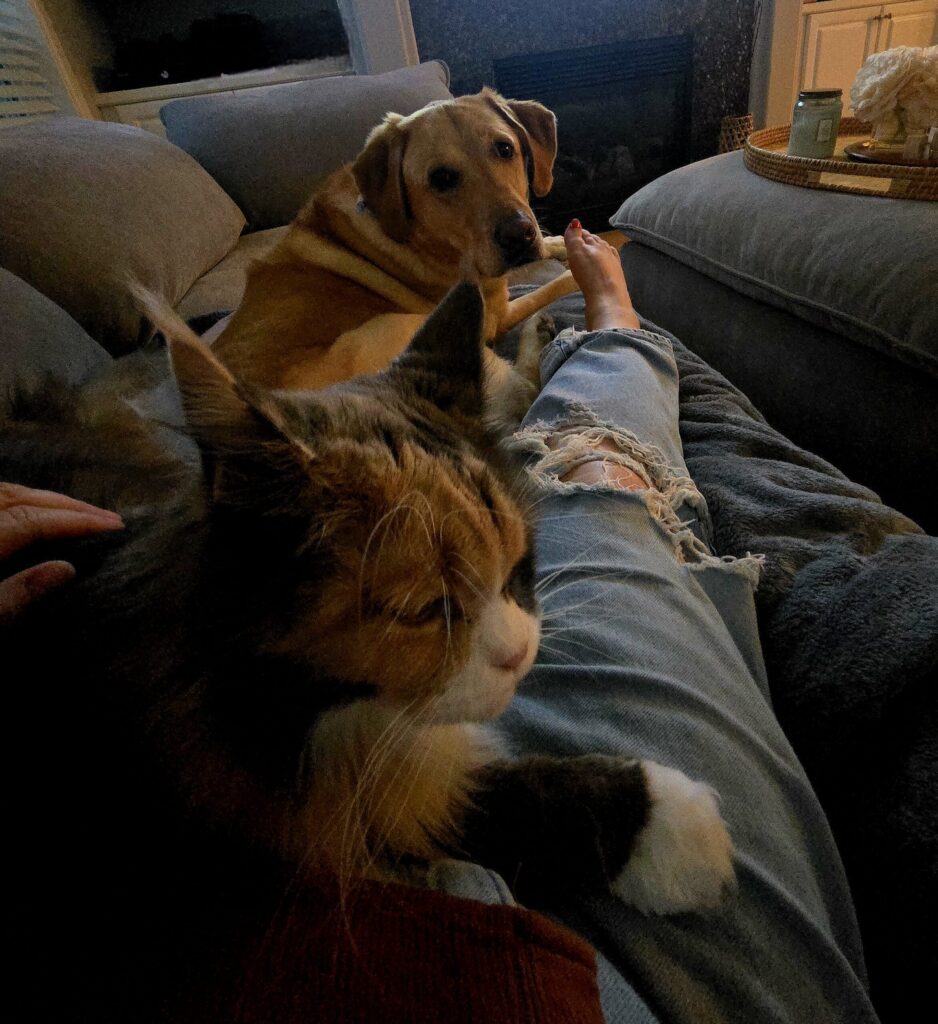
Creating successful multi-pet household harmony isn’t about achieving picture-perfect moments where dogs and cats cuddle together, though those certainly happen in our house. It’s about designing home environments and family rhythms that allow different species to coexist peacefully while maintaining their individual personalities and meeting their unique needs.
Through our journey with Boomer’s gentle leadership, Luna’s adventurous kitten energy, and Penelope’s dignified recovery process, I’ve learned that the most successful multi-pet households focus on preventing problems rather than solving conflicts. When each animal feels secure in their resources, territory, and human relationships, natural harmony emerges without force or manipulation.
Every multi-pet family will look different based on the personalities, species, ages, and histories of the animals involved. Some households develop close inter-species friendships, while others maintain peaceful coexistence with minimal direct interaction. Both outcomes represent success when all animals feel safe, comfortable, and genuinely loved.
Start with observation. Watch how your pets naturally interact, what triggers stress or excitement, and where each animal gravitates for comfort and security. Build from these insights, whether adjusting feeding locations, adding vertical territory, or modifying routine timing to reduce potential conflicts.
The magic happens when safety meets comfort, when individual needs are respected, and when every family member feels genuinely valued in their shared home. Small changes often create profound differences in daily harmony and happiness for everyone involved.
Remember, you’re not just managing multiple pets. You’re orchestrating a complex family dynamic where every tail wag, contented purr, and peaceful coexistence moment becomes part of a beautiful household rhythm that enriches everyone’s daily experience.
Frequently Asked Questions
How long does it take for dogs and cats to adjust to living together?
Adjustment timelines vary dramatically by individual personality, age, and past experiences. Kittens like Luna often adapt within days to weeks, while adult cats like Penelope may need several months. Success isn’t measured by speed but by each animal’s comfort level and stress-free coexistence.
What’s the biggest mistake people make when introducing dogs and cats?
Forcing interaction too quickly. Many people expect immediate friendship and push animals together before they’re ready. The most successful introductions happen gradually, respecting each animal’s adaptation pace and providing escape routes throughout the process.
Can any dog live successfully with cats?
Most dogs can learn to coexist peacefully with cats through proper introduction and management. However, dogs with strong prey drives or those bred specifically for hunting may require more intensive training and supervision. Gentle temperaments like Boomer’s make the process significantly easier.
Do I need separate litter boxes if my dog doesn’t bother the cats during elimination?
Yes. Even if your dog doesn’t directly interfere, cats need private, secure elimination options. Follow the “n+1” rule (one box per cat plus one extra) and position boxes in areas with low dog traffic to prevent stress and litter box avoidance.
Is it normal for my cat to hiss at my dog even after months together?
Occasional hissing can be normal communication, especially if the dog approaches too quickly or enters the cat’s preferred space. However, frequent or escalating hissing may indicate stress that requires environmental adjustments or increased separation. Monitor for stress signals like hiding, appetite changes, or litter box issues.
Should I let my dog and cat sleep together?
Only if both animals choose this arrangement voluntarily and both appear completely relaxed. Never force sleeping proximity. Many successful multi-pet households maintain separate sleeping areas, which is perfectly healthy and often preferred by the animals themselves.
Ready to create species-specific sanctuaries within your multi-pet home? Explore our guides on dog-friendly home design and cat sanctuaries at home for detailed strategies that complement these multi-pet principles.
At Joyfolk Pets, we believe wellness begins in the everyday moments we share with our animals.
Rooted in Nature. Made with Heart.